Bank & Financial Building Roofing starts with the actual roof condition.
A bank branch is a small roof with outsized consequences. The footprint is modest, but what sits below it, the vault, the server room, the cash recyclers, the customer floor, turns a minor water intrusion into an immediate operational problem, and the building is rarely closed long enough to give a roofer a comfortable window. These are high-visibility, business-hours buildings where the work has to be quiet, clean, and almost invisible to anyone walking up to make a deposit. We scope financial-building roofing around minimal disruption and tight access, because that is what the building demands.
Baltimore's financial buildings run from downtown high-rise lobby branches to suburban pad-site banks. You find corporate and commercial banking floors in the office towers around the Inner Harbor and Pratt Street business district, retail branches lining commuter corridors like York Road, Reisterstown Road, and Route 40, and freestanding branches with drive-throughs anchoring shopping-center outparcels in Towson, Catonsville, and White Marsh. Credit unions tied to the region's large employers, including the medical and university institutions and the federal agencies in the area, add another layer of branches and small headquarters buildings to the market.
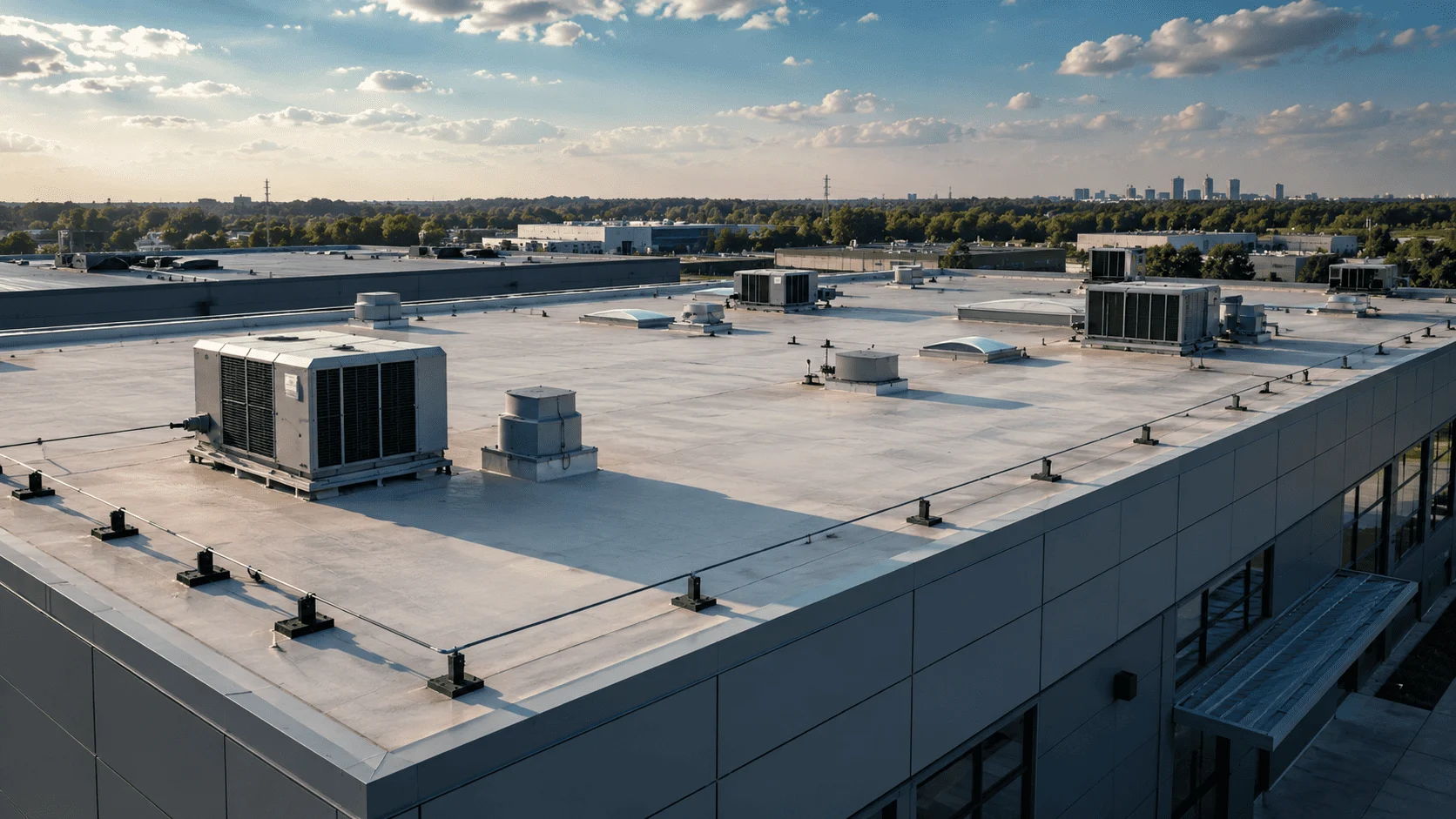
The roof on a typical branch carries more penetrations than its size suggests. The drive-through canopy ties back into the building, the ATM kiosk has its own enclosure, the standby generator's transfer switch room vents through the roof, and the server and equipment rooms run precision cooling units up top because banking systems cannot tolerate a temperature swing. Each of those is a discrete flashing condition over a building where a drip in the wrong spot means a branch closes for the day. We document all of it before pricing rather than discovering it mid-project.
The drive-through canopy is where the leaks live
On retail bank branches, the single most common chronic leak is the connection where the drive-through canopy meets the main building wall. That joint takes constant thermal cycling, it catches overspray and runoff from vehicles, and over years it sees differential settlement between the canopy structure and the building. Standard retail flashing details are not built to take that kind of repeated movement for the long haul, which is why these leaks keep coming back. We treat the canopy-to-building transition as its own line item, evaluate it separately from the field membrane, and when it has deteriorated we re-flash it with a detail designed for the movement it actually experiences. Replacing the field membrane alone never fixes a canopy-transition leak, and we will not pretend it does.
Access at a financial building is governed more tightly than at almost any other commercial property. Contractor badging, escort requirements for vault-adjacent areas, and security-camera documentation of crew activity are standard at bank-owned sites in Baltimore. We build the security-coordination timeline and crew credentialing into the bid schedule from the start, so badging and escort logistics are planned rather than sprung as a surprise that adds cost after the contract is signed. Where the building drawings show vault or secure-room locations, we identify those roof zones up front and sequence work over them into approved windows, confirming with the security team that no active operations are affected by vibration or temporary access changes.
Branches are typically open Monday through Saturday, and the work has to flow around that. We concentrate active tear-off and installation into off-hours and weekends, and we confirm daily dry-in before the branch opens each morning, because a watertight roof at opening time is non-negotiable. Noise limits during customer-service hours and any security escort requirements for roof access are coordinated with the branch manager and the corporate facilities team before mobilization. The goal is a customer walking in on Monday with no idea a roof was replaced over the weekend.