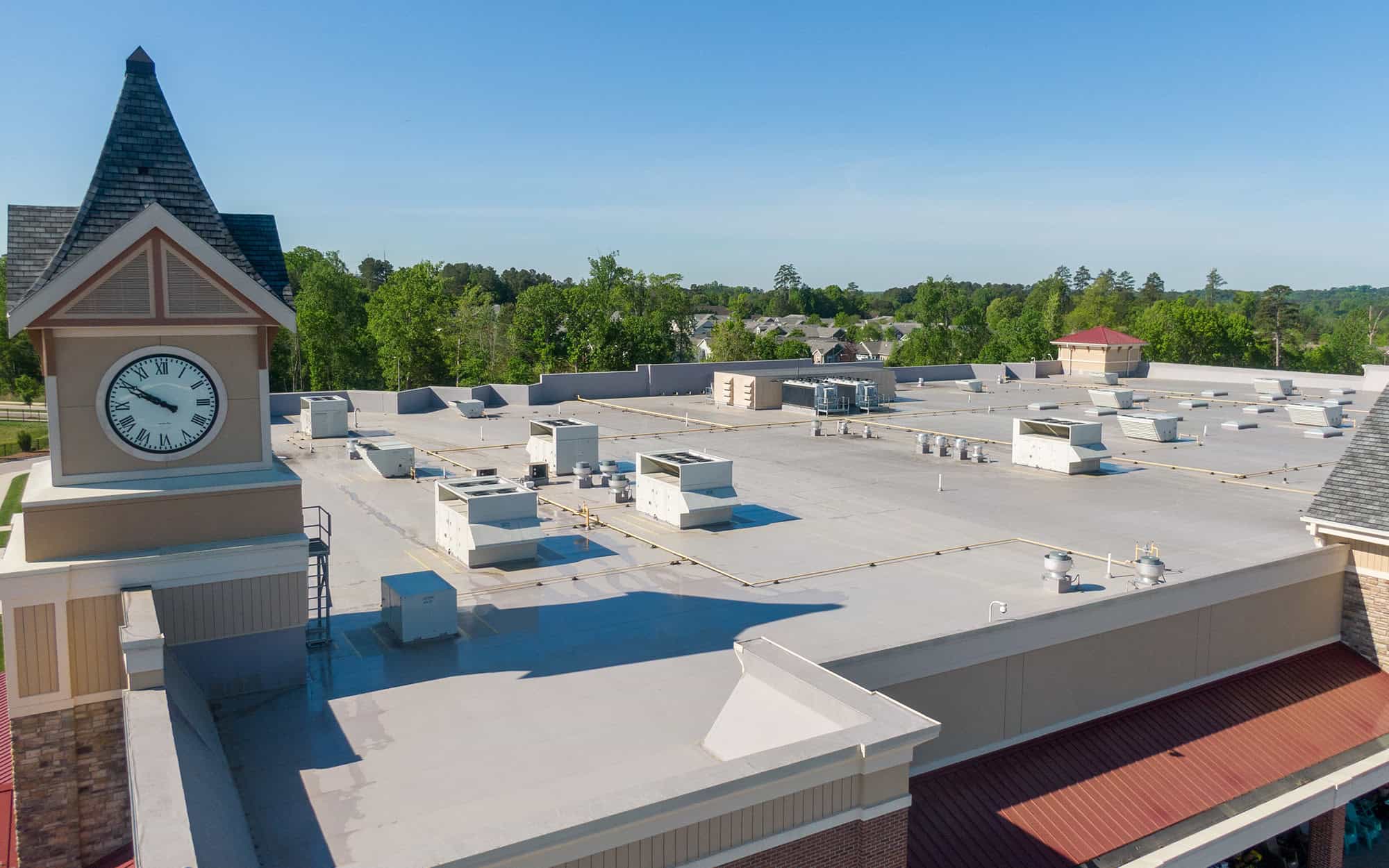
REIT Roofing Services starts with the actual roof condition.
a national REIT maintains a significant office portfolio in the Baltimore-Washington corridor, with assets in the Inner Harbor, Canton, and suburban Maryland submarkets that serve federal contractors, healthcare organizations, and professional services firms anchoring the metro's commercial tenant base. Asset managers overseeing a national REIT's Maryland assets manage roof systems on buildings where institutional tenants hold long-duration leases and where building systems performance directly supports the lease renewal economics that sustain NOI through market cycles.
Office and mixed-use portfolio roofing management in Baltimore requires a vendor program calibrated to the complexity of urban commercial assets. Multi-story office buildings in the Inner Harbor and Fells Point carry roof systems that integrate flat membranes, mechanical equipment platforms, and architectural features that require contractor experience in urban commercial environments, fall protection compliance, occupied building scheduling, coordination with building engineering staff, and reporting formats suited to multi-property institutional oversight. A master service agreement with one qualified Baltimore-area contractor creates the operational consistency that REIT asset managers need to maintain data quality and response reliability across a dense urban property book.
The NOI impact of roof deferred maintenance on Baltimore office properties runs through tenant retention channels that are specific to the city's institutional tenant composition. Federal contractors and healthcare organizations occupying a national REIT's Maryland office buildings operate on facility standards that affect lease renewal decisions in ways that go beyond rent economics. A building with documented maintenance incidents, roof failures, water infiltration, repeated emergency repair activity, creates a paper trail that sophisticated facility managers reference when evaluating lease renewal versus relocation. Asset managers who maintain roof condition as a building systems performance standard protect the tenant relationships that sustain NOI through lease cycles.
Annual CAPEX planning for Baltimore portfolio assets feeds a capital planning process that a national REIT's investor relations team presents to analysts with institutional precision. Office buildings require multi-system CAPEX budgets where the roof line carries specific weight, at Baltimore construction costs, a full roof replacement on a 150,000-square-foot office building represents a seven-figure capital event that needs documented support in the reserve model years before execution. Asset managers who carry that number with current condition ratings and remaining useful life documentation show investors the capital planning discipline that sustains investor confidence through Baltimore's real estate market cycles.
A property manager overseeing eleven Baltimore commercial assets, harbor-front office towers, suburban office parks in Towson and Columbia, and mixed-use assets in the neighborhood commercial corridors, faces an operational complexity that has no room for vendor fragmentation. Managing eleven separate roofing contractors means eleven different emergency contact protocols, eleven different insurance certificates to verify, and eleven different inspection report formats to reconcile into one CAPEX worksheet. A preferred vendor under a master service agreement who knows every building in the portfolio reduces that administrative load while improving data consistency and emergency response reliability.
REIT accounting for roofing on Baltimore office assets follows the CapEx-versus-OpEx framework that a national REIT controllers apply with external audit rigor. Full membrane replacements are capitalized and depreciated. Maintenance and emergency repairs are expensed. For gross-lease office tenants, the standard structure in a national REIT's Maryland portfolio, the REIT carries roof costs directly, making condition management a first-dollar P&L exposure. Some Baltimore office leases include building systems performance standards as covenant terms, creating additional contractual incentive for the REIT to maintain documented condition standards.
Baltimore's position in the Baltimore-Washington corridor has sustained steady institutional acquisition activity driven by federal government proximity and the metro's healthcare and education employment base. REITs acquiring value-add office assets in the Inner Harbor and suburban Maryland submarkets frequently encounter buildings where private or smaller institutional owners managed capital conservatively during occupancy softness cycles. Roof systems on these acquired assets may reflect deferred maintenance that compresses seller costs but transfers capital exposure to the acquirer. Pre-closing PCAs with detailed roofing assessments give acquisition teams the data to price that exposure accurately.
Property condition assessments for Baltimore acquisitions require a roofing contractor who understands the institutional reporting standard and can deliver within commercial closing timelines, typically 10 to 21 days from access authorization to written findings. For urban office properties, the PCA scope should address each roof section's membrane condition, mechanical equipment platform and curb conditions, all penetration and flashing integrity, interior drain systems, and parapet wall conditions. Cost projections must distinguish immediate needs from phased CAPEX with defined timing, in formats suitable for direct input into acquisition underwriting models.